
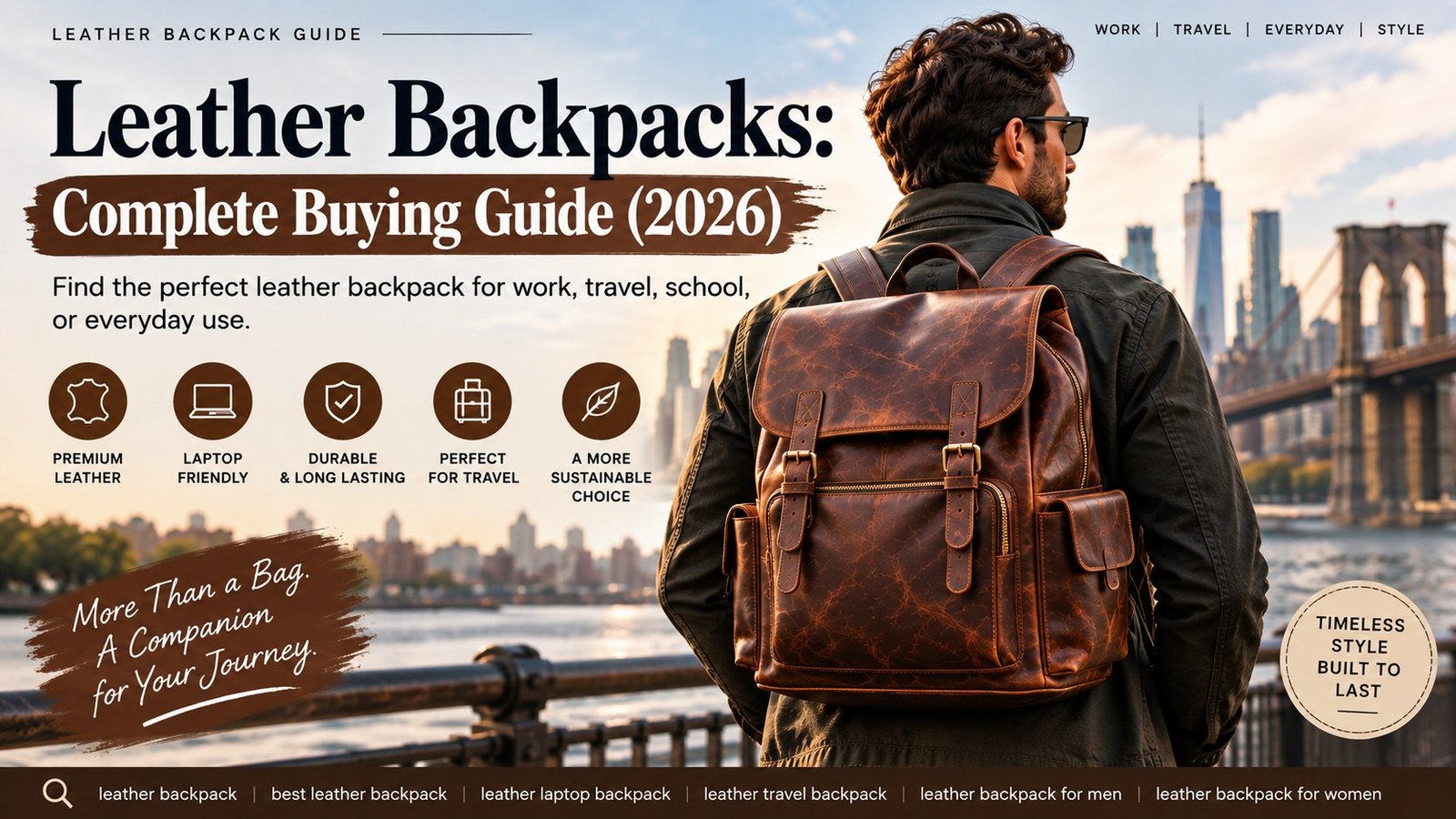
Leather Backpacks: Complete Buying Guide (2026)
A leather backpack can be much more than a bag you throw over your shoulders.
Choose the right one, and you may have a backpack that follows you to work, weekend trips, coffee shops, airports, and everyday errands for years.
Choose the wrong one, and you could end up with a heavy bag, uncomfortable straps, weak hardware, or leather that starts looking worn much sooner than expected.
So, how do you know which leather backpack is actually worth your money?
In this Leather Backpacks: Complete Buying Guide (2026), you’ll learn how to compare leather quality, size, laptop storage, comfort, hardware, organization, style, and price before buying.
Whether you’re looking for a leather backpack for men, a leather backpack for women, a professional work bag, or a leather travel backpack, this guide will help you make a smarter choice.
Key Takeaways
Before you buy a leather backpack, remember these points:
- Full-grain leather is usually the premium choice when durability matters.
- Choose your backpack based on what you’ll actually carry.
- Check the real dimensions of the laptop compartment.
- Comfortable and adjustable shoulder straps matter.
- Good zippers, buckles, stitching, and hardware are signs of better construction.
- More pockets aren’t always better. Useful organization matters more.
- Leather backpacks are often heavier than synthetic alternatives.
- A quality leather backpack should be viewed as a long-term purchase.
Why Buy a Leather Backpack?
You have hundreds of backpack options today.
Nylon, polyester, canvas, and technical materials can all make good backpacks.
So why choose leather?
For many people, it comes down to a combination of style, durability, character, and versatility.
A good leather backpack can fit naturally into both casual and professional settings.
You can wear one with jeans and sneakers on Saturday, then carry the same backpack to your office on Monday.
Leather Develops Character Over Time
One reason people love real leather is that it changes as you use it.
High-quality leather can develop a natural patina over time.
Small changes in color and texture can make your backpack feel more personal.
Instead of simply looking old, quality leather can become richer and more distinctive.
What Is the Best Leather for a Backpack?
The type of leather should be one of the first things you check.
Not every product labeled “leather” offers the same quality.
Understanding a few basic terms can save you from making an expensive mistake.
Full-Grain Leather
Full-grain leather keeps the natural outer surface of the hide with minimal alteration.
You may notice natural grain variations or small marks.
Those details aren’t necessarily defects.
They’re often part of what gives full-grain leather its character.
Top-Grain Leather
Top-grain leather has more surface treatment than full-grain leather.
It usually offers a smoother and more uniform appearance.
A well-made top-grain leather backpack can still be an excellent option for everyday and professional use.
Genuine Leather
The words genuine leather tell you that real leather is present, but they don’t automatically mean you’re getting premium leather.
Always look beyond the label.
Check:
- Leather type
- Stitching
- Hardware
- Lining
- Construction
- Warranty
- Seller transparency
Bonded Leather
Bonded leather is generally made from leather fibers or scraps combined with other materials.
If you want the long-term benefits of quality leather, it usually isn’t the first option I’d recommend.
Leather Quality Comparison
| Leather Type | Durability | Appearance | Best For |
|---|---|---|---|
| Full-Grain Leather | Excellent | Natural and unique | Long-term premium use |
| Top-Grain Leather | Very Good | Smooth and refined | Work and everyday use |
| Genuine Leather | Varies | Varies | Budget-conscious buyers |
| Bonded Leather | Lower | Uniform | Lower-cost products |
How Big Should Your Leather Backpack Be?
Size is one of the easiest things to get wrong when buying a backpack online.
A backpack may look perfect in a product photo but feel completely different once it’s on your back.
Before buying, think about what you normally carry.
Ask yourself:
- Do you carry a laptop?
- What size is your laptop?
- Do you carry notebooks?
- Do you need space for a jacket?
- Do you carry a camera?
- Will you travel with the backpack?
- Do you need a water bottle?
- Are you using it mainly for work?
Your answers should determine the size you choose.
Leather Backpack Size Guide
| Backpack Size | Best Use |
|---|---|
| Small | Phone, wallet, tablet, daily essentials |
| Medium | Work, commuting, laptop, notebooks |
| Large | Travel, larger laptops, extra clothing |
| Oversized | Heavy travel or specialized equipment |
Don’t automatically buy the largest backpack available.
More space can also mean more weight and bulk.
Watch: How to Choose a Good Backpack
Before choosing your bag, this video gives you a useful visual explanation of construction, fit, function, and the features that really matter.
The advice in the video applies well when you’re comparing leather backpacks too. Pay attention to how the bag fits your body, how the straps feel, how the compartments are arranged, and whether the construction makes sense for your daily use.
Buying a Leather Laptop Backpack
If you’re carrying a laptop, don’t simply trust a label such as:
“Fits a 15-inch laptop.”
Check the actual internal dimensions.
Two laptops with the same screen size can have different widths and thicknesses.
A Good Leather Laptop Backpack Should Have:
- A dedicated laptop compartment
- Padding around your laptop
- A secure opening
- Enough room without excessive movement
- Separation from other hard objects
- Easy access when needed

Check the Shoulder Straps
You can buy beautiful leather.
You can have perfect stitching.
You can choose expensive hardware.
But if the backpack hurts your shoulders after 20 minutes, none of that matters much.
Look for:
- Wide shoulder straps
- Adjustable straps
- Padding
- Strong attachment points
- A comfortable back panel
Remember that leather itself adds weight.
Once you add your laptop, charger, books, and other items, your backpack may become much heavier.
Check the Stitching Before You Buy
Stitching can tell you a lot about overall quality.
Look closely at product photos.
You want stitching that appears:
- Straight
- Even
- Tight
- Consistent
- Reinforced at stress points
Pay special attention to the areas where the shoulder straps connect to the backpack.
These areas carry most of the load.
Don’t Ignore the Zippers and Hardware
Leather gets most of the attention, but hardware matters just as much.
A beautiful backpack becomes frustrating very quickly if the zipper fails.
Look at:
- Main zippers
- Buckles
- Snaps
- Rivets
- Strap adjusters
- Metal hooks
- Handles
Ask yourself:
Does this hardware look strong enough for years of regular use?
That’s more important than whether it simply looks expensive.
Organization: How Many Pockets Do You Need?
Some leather backpacks give you one large open compartment.
Others give you a pocket for almost everything.
Neither approach is automatically better.
Think about your routine.
If you’re commuting to work, you may want:
- Laptop compartment
- Charger pocket
- Phone pocket
- Pen slots
- Notebook space
- Key pocket
If you’re traveling, you may also want:
- Quick-access exterior pocket
- Passport pocket
- Water bottle holder
- Larger main compartment
- Luggage sleeve
The goal isn’t to find the backpack with the most pockets.
It’s to find one with the right pockets.
What Style of Leather Backpack Should You Choose?
Your lifestyle should guide your decision.
Classic Leather Backpack
A classic leather backpack usually has a simple silhouette and works well for everyday use.
Best for:
- Everyday carry
- Casual wear
- Coffee shops
- Light work use
Leather Laptop Backpack
This style is designed around technology.
You’ll usually get a dedicated laptop compartment and better organization for chargers and accessories.
Best for:
- Office workers
- Students
- Remote workers
- Business travelers
Leather Travel Backpack
Travel backpacks usually offer more internal space and easier organization.
Best for:
- Weekend trips
- Business travel
- Road trips
- Short vacations
Vintage Leather Backpack
If you enjoy a rugged look, vintage-style leather backpacks can be a great fit.
You may find:
- Distressed leather
- Antique-style hardware
- Buckle closures
- Large front pockets
- Natural brown tones
Minimalist Leather Backpack
Prefer a cleaner look?
Choose a backpack with:
- Hidden pockets
- Simple lines
- Limited hardware
- Black or smooth brown leather
- Minimal branding
Best Leather Backpack for Work
Your work backpack needs to look good, but function should come first.
For office use, prioritize:
- Laptop protection
- Comfortable straps
- Clean design
- Useful organization
- Secure closure
- Durable leather
- Strong hardware
Black and dark brown are usually easy to match with professional clothing.
Cognac leather offers a warmer, slightly more relaxed look.
Best Leather Backpack for Travel
Buying a leather backpack for travel?
Think about weight.
Leather can be heavier than lightweight technical fabrics.
For a weekend trip, that may not bother you.
For long walking days, it can matter a lot.
Look for:
- Comfortable shoulder straps
- Secure zippers
- Passport pocket
- Laptop compartment
- Luggage pass-through
- Strong handle
- Useful capacity
- Organized interior
Also check your airline’s current carry-on requirements before traveling.
Brown vs. Black Leather Backpack
Can’t decide between brown and black?
Both are excellent options.
Brown Leather Backpack
Brown highlights the character of leather beautifully.
Popular shades include:
- Cognac
- Tan
- Chocolate
- Dark brown
Brown works especially well with casual and smart-casual outfits.
Black Leather Backpack
A black leather backpack usually feels cleaner and more modern.
It pairs easily with:
- Business clothing
- Minimalist outfits
- Black jackets
- Gray clothing
- Urban fashion
Brown vs. Black Leather Backpack
| Feature | Brown | Black |
|---|---|---|
| Classic leather look | ⭐⭐⭐⭐⭐ | ⭐⭐⭐⭐ |
| Professional style | ⭐⭐⭐⭐ | ⭐⭐⭐⭐⭐ |
| Shows patina | ⭐⭐⭐⭐⭐ | ⭐⭐⭐ |
| Easy to match | ⭐⭐⭐⭐ | ⭐⭐⭐⭐⭐ |
| Vintage style | ⭐⭐⭐⭐⭐ | ⭐⭐⭐ |
| Minimalist style | ⭐⭐⭐ | ⭐⭐⭐⭐⭐ |
How Much Should You Spend on a Leather Backpack?
There’s no perfect price.
Leather backpacks can range from affordable bags to handmade premium pieces costing hundreds of dollars.
A higher price doesn’t automatically mean better quality.
Before paying more, ask what you’re getting.
You may be paying for:
- Better leather
- Better hardware
- Better construction
- More complex design
- Better lining
- Brand reputation
- Craftsmanship
- Warranty
- Manufacturing location
- Personalization
Don’t buy based on price alone.
Evaluate the entire backpack.
Leather Backpack Buying Checklist
Before clicking Buy, go through this checklist.
Leather
- Is the leather type clearly stated?
- Is it full-grain or top-grain?
- Can you see close-up leather photos?
Construction
- Does the stitching look even?
- Are stress points reinforced?
- Are the straps securely attached?
Comfort
- Are the straps adjustable?
- Are they padded?
- Is the backpack already heavy when empty?
Laptop
- Does your laptop actually fit?
- Is the compartment padded?
- Is it protected from other items?
Organization
- Do the pockets match your needs?
- Is there quick-access storage?
- Do you need a bottle pocket?
Hardware
- Do the zippers look durable?
- Are the buckles strong?
- Are handles reinforced?
Seller
- Is there a return policy?
- Is there a warranty?
- Are dimensions clearly listed?
- Are there real reviews or customer photos?
Red Flags to Watch For
“Premium Leather” With No Details
Premium isn’t a leather grade.
You should know what type of leather you’re actually getting.
No Interior Photos
You need to see how the inside is organized.
No Dimensions
Beautiful pictures aren’t enough.
You need measurements.
Weak Strap Attachments
The shoulder straps carry the entire load.
Look for strong reinforcement.
Heavily Edited Product Photos
Real leather has texture.
If you can’t see any natural texture or grain in the photos, look for more information.
How to Care for Your Leather Backpack
Buying quality leather is only half the job.
You also need to care for it.
Basic leather backpack care:
- Wipe away dust with a soft cloth.
- Don’t soak the leather.
- Let wet leather dry naturally.
- Avoid direct heat.
- Use leather conditioner when appropriate.
- Test cleaning products first.
- Store the bag in a cool, dry place.
- Remove heavy items during long-term storage.
Always follow the manufacturer’s care instructions.
Is a Leather Backpack Worth It?
For the right person, yes.
A leather backpack may be a good choice if you want:
- A professional appearance
- Long-term use
- Natural character
- A bag that develops patina
- Something versatile enough for work and casual wear
But leather isn’t automatically best for everyone.
If you’re hiking long distances or trying to minimize weight, a technical backpack may be more practical.
Your best backpack is the one that matches your real lifestyle.
FAQ About Leather Backpacks
Are leather backpacks durable?
Yes, high-quality leather backpacks can be very durable when they use good leather, strong stitching, and reliable hardware.
Is full-grain leather good for backpacks?
Yes. Full-grain leather is one of the most popular choices for premium leather backpacks because of its durability and natural character.
Are leather backpacks heavy?
They can be heavier than synthetic backpacks because leather is naturally denser.
Can you use a leather backpack for work?
Absolutely. A clean leather backpack with laptop protection and useful organization can work very well in a professional environment.
Are leather backpacks good for laptops?
Yes, as long as your backpack includes a properly sized and padded laptop compartment.
What color leather backpack should you buy?
Black is excellent for professional and minimalist use. Brown, cognac, and tan offer a warmer and more traditional appearance.
Can you travel with a leather backpack?
Yes. Leather backpacks can be excellent for short trips and business travel, especially when they have comfortable straps and useful organization.
Does real leather scratch?
Yes. Natural leather can develop marks and scratches. On many full-grain leather products, these become part of the patina.
Is an expensive leather backpack always better?
No. Price can reflect materials, branding, craftsmanship, or manufacturing costs. Compare construction and features before making your decision.
What Size Leather Backpack Do You Actually Need?
Capacity is where most buyers guess, and guessing usually means carrying a bag that is either half empty or permanently overstuffed. Backpack volume is measured in litres, and a few reference points make the choice much easier.
A 10 to 14 litre leather backpack is a compact everyday bag. It holds a tablet, a slim notebook, a wallet, keys and a water bottle, and it sits close to the back without looking bulky. This is the size to pick if you mainly commute light or want a bag that works with smarter clothes.
A 15 to 20 litre bag is the common sweet spot for work and study. It takes a 13 to 15 inch laptop with its charger, a folder of documents, lunch and a light jacket. If you are buying one leather backpack to cover most of your week, this range is the safest bet.
A 20 to 30 litre backpack moves into weekend and travel territory. It carries a change of clothes, a toiletry bag and a 16 inch laptop, and it will normally still pass as cabin luggage on most airlines. Bear in mind that leather is heavier than nylon, so a large leather bag can feel substantial before you have packed anything at all.
Leather Backpack Price Tiers and What They Buy You
Price is not a perfect guide to quality, but it does track fairly closely with materials and construction. Below roughly one hundred euros or dollars, you are usually looking at split, bonded or coated leather with plated hardware. Such a bag can look good for a season, but the coating tends to flake and the stitching rarely survives heavy daily loads.
In the middle band, roughly one to three hundred, you start to find genuine top-grain leather, better zippers and a properly lined interior. This is where most buyers get the best value, particularly from smaller makers who publish the tannery and the leather grade they use.
Above that, you are paying for full-grain vegetable-tanned hides, hand-finished edges, solid brass fittings and, often, a repair service. A bag at this level should be judged over ten years rather than one, and the cost per year of ownership can end up lower than a cheap backpack you replace twice.
Quick Leather Backpack Buying Checklist
If you only have a few minutes before you buy, run the bag through this short checklist. It covers the details that most often separate a backpack you keep for a decade from one you replace within a year, and it works whether you are shopping in a store or online.
- Leather type: look for full-grain or top-grain, and be cautious with vague labels such as “genuine leather” or “bonded leather”.
- Stitching: tight, even rows with reinforced bar-tacks where the straps meet the body.
- Hardware: solid brass or stainless steel zippers and buckles rather than thin plated metal that chips.
- Lining and pockets: a padded laptop sleeve, a lined interior, and at least one secure zip pocket.
- Straps and comfort: wide, padded, adjustable straps, plus a padded back panel if you carry a laptop daily.
- Weight when empty: under roughly 1.5 kg for a daily commuter bag.
- Warranty and returns: a clear repair or return policy is a strong signal of build quality.
Further Reading and Resources
Once your leather backpack arrives, keeping it in shape matters as much as the purchase. Our guide to how to clean leather covers safe products and technique, the leather repair kit walkthrough shows how to deal with scratches and cracks, and if you would rather build your own bag, see our roundup of essential leatherworkers tools.
For independent background on how hides are tanned and graded, see the overview of leather on Wikipedia and the environmental audit standards published by the Leather Working Group.
Final Thoughts: Choosing the Right Leather Backpack
Buying a leather backpack becomes much easier when you stop focusing only on appearance.
One last habit is worth building: whatever bag you choose, condition the leather two or three times a year, empty it before storing it, and keep it away from radiators and direct sunlight. Leather that is fed and dried slowly stays supple, while leather that is soaked and then baked dry is what cracks. A good leather backpack rewards small amounts of regular care far more than occasional deep cleaning, and that routine costs you only a few minutes each season.
Yes, your backpack should look good.
But you also need to think about how you’re actually going to use it.
Start with the leather.
Then check the size, laptop compartment, straps, stitching, zippers, interior organization, and overall weight.
If you’re buying your backpack for work, prioritize clean design and laptop protection.
If you’re buying it for travel, pay extra attention to comfort, capacity, weight, and organization.
And if you’re buying one simply because you love the timeless look of leather, choose something you’re going to enjoy using—not just something that looks good in a product photo.
The best leather backpack isn’t necessarily the most expensive one. It’s the backpack that fits your needs today and still makes you want to carry it years from now.
Key Takeaways
- Choose leather quality first.
- Full-grain leather is a strong premium option.
- Measure your laptop instead of trusting labels alone.
- Check the backpack’s empty weight.
- Comfortable straps matter.
- Inspect stitching and hardware.
- Choose useful organization instead of unnecessary pockets.
- Match the style to your daily routine.
- Take proper care of your leather.
- Buy for your lifestyle, not just appearance.